
This content originally appeared on Level Up Coding - Medium and was authored by Mohit Sewak, Ph.D.
A definitive review of the paradigm shift poised to overcome classical computational limits in machines.
The next leap in AI isn’t just about more data; it’s about a fundamentally new way of thinking.
Alright, pull up a chair. Let me pour you a cup of my special masala chai. The secret? A tiny bit more ginger than you think you need. It’s a lot like the topic we’re about to dive into: Quantum Reinforcement Learning. It sounds intimidating, maybe a little weird, but that extra kick is exactly what’s about to change the game for artificial intelligence.
You’ve seen the magic of Generative AI, right? You’ve asked it to write a Shakespearean sonnet about your cat, to create an image of a cyber-punk samurai riding a robotic T-Rex, and maybe even to debug that pesky bit of code that was giving you a headache. It’s brilliant. It’s transformative.
But I’m here to tell you a secret. As an AI guy who’s spent more time in the digital trenches than I care to admit, I can tell you that for all its creative flair, today’s Generative AI is like a brilliant art student who can perfectly replicate any style but can’t invent a new one. It’s fantastic at generating content based on the universe of data it has already seen.
The next great leap — the one that will define this century — isn’t about generating prettier pictures or more eloquent poems. It’s about generating strategy. It’s about creating an AI that can look at a problem so complex, so full of possibilities that it would make our biggest supercomputers cry, and find the perfect, undiscovered solution.
This is the shift from generating content to generating solutions. And the engine for this new world? It’s the beautiful, mind-bending fusion of quantum computing and reinforcement learning.
I. The Stakes: When Your GPS Has a Nervous Breakdown
Ever tried to plan a multi-stop trip on Google Maps? Three stops, easy. Five stops, a bit of a puzzle. Now, imagine you’re running FedEx. You have 50 packages to deliver across a city. The number of possible routes isn’t just big; it’s astronomically, nonsensically, laughably big. We’re talking more possible routes than there are atoms in the known universe. This, my friend, is the “curse of dimensionality” (Bellman, 1957).
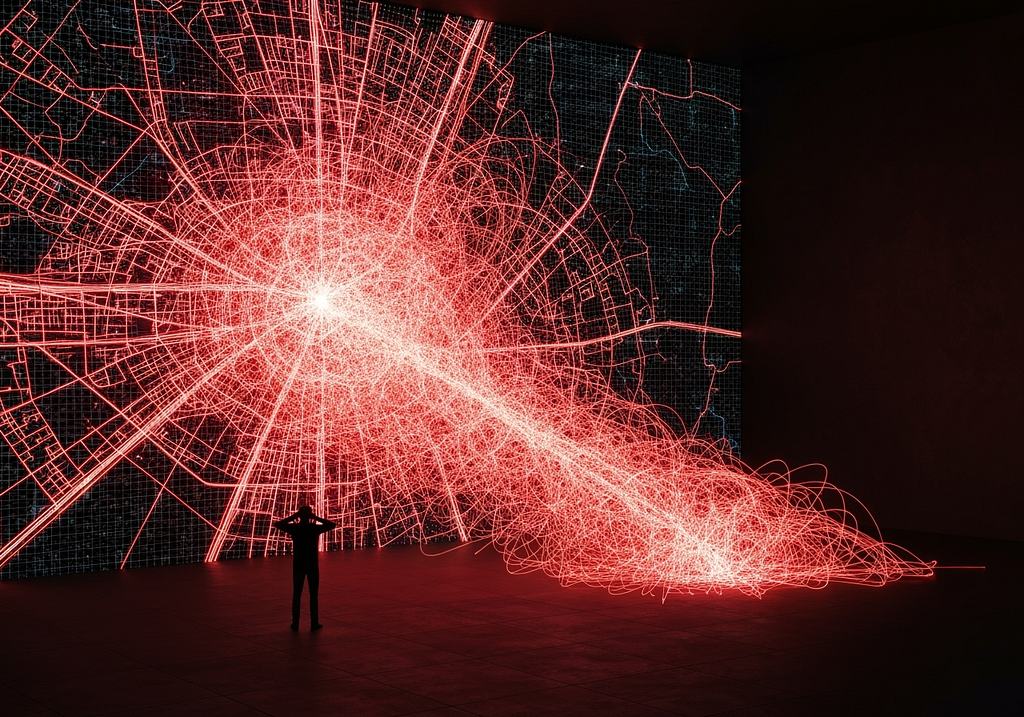
This is the “curse of dimensionality” — when the number of possible solutions is so vast it breaks classical computers.
It’s the wall that classical computing is slamming into at full speed.
“We are stuck with technology when what we really want is just stuff that works.” — Douglas Adams
This isn’t just about delivering packages. This is the hidden bottleneck in our most critical industries:
- Logistics & Supply Chains: We settle for “pretty good” shipping routes because finding the truly optimal one is computationally impossible.
- Finance: Traders build models to navigate the chaotic storm of the stock market, but they’re always a step behind. A truly optimal strategy that could account for thousands of interacting variables remains out of reach (Kyriazis et al., 2023).
- Drug Discovery: Imagine trying to find the one key that fits a specific lock by testing billions upon billions of keys, one by one. That’s what designing a new drug is like. We’re wandering through a near-infinite molecular space, hoping to get lucky.
We’re leaving trillions of dollars and world-changing scientific breakthroughs on the table, all because our current tools, for all their power, get stuck in a computational traffic jam. We need a new kind of car. Or better yet, a teleporter.
ProTip: Don’t try to understand quantum mechanics. Just understand what it does. Thinking about a particle being in two places at once will make your brain feel like a pretzel. Instead, think of it as a computing superpower. It’s less about the “how” and more about the “wow.”
II. The Quantum Superpowers: A New Toolkit for Intelligence
So, how does this quantum stuff help? It’s not just about being “faster.” A quantum computer doesn’t just run the same race faster; it changes the rules of the race itself. Our hero, the Quantum Reinforcement Learning (QRL) agent, has three superpowers that its classical cousins can only dream of.
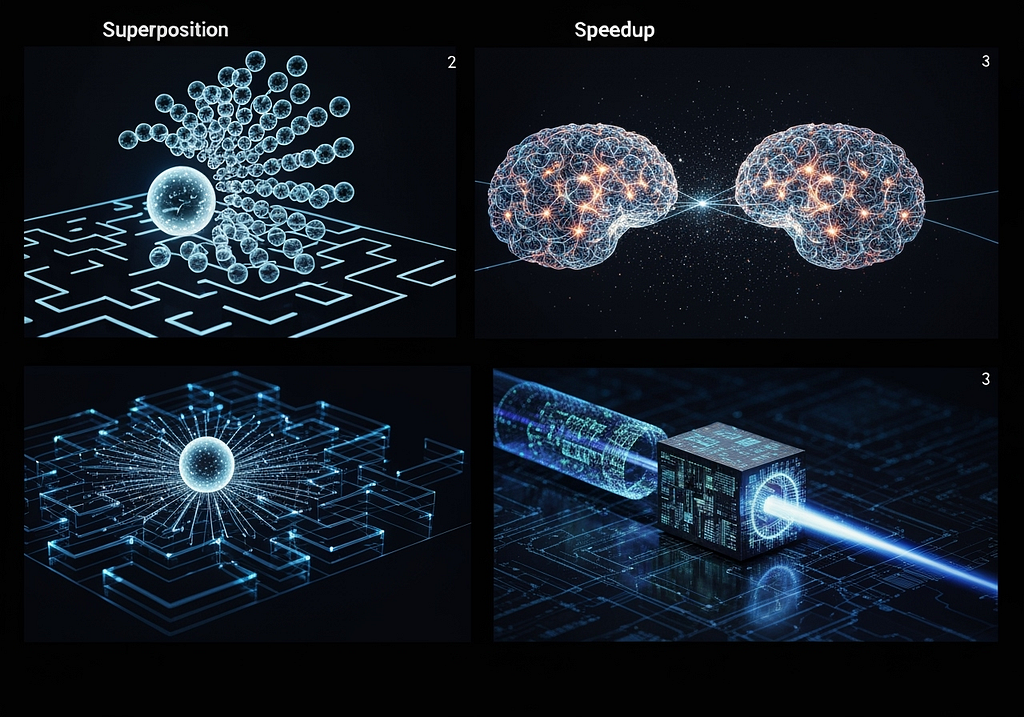
Superposition, Entanglement, and Speedup: The three quantum abilities that redefine what’s possible for AI.
A. Superpower 1: The “Explore-It-All” Glitch (Superposition)
Imagine a classical AI trying to solve a maze. It runs down one path, hits a dead end, turns around, and tries another. It’s tedious, one-at-a-time work.
A QRL agent, thanks to superposition, can explore every single path in the maze at the same time. It’s like it exists in a quantum ghost-state, trying all possibilities simultaneously. This allows it to find the most promising direction almost instantly, dramatically accelerating the learning process (Dong et al., 2008). It’s not about trial and error anymore; it’s about seeing all trials and eliminating all errors in one go.
B. Superpower 2: The Cosmic Spidey-Sense (Entanglement)
Entanglement is what Einstein famously called “spooky action at a distance.” It’s a deep, intrinsic connection between quantum particles. For our AI agent, this translates into an incredible ability to understand complex correlations in data that would baffle a classical model.
This means quantum models can be ridiculously efficient. Researchers developing a Quantum Soft Actor-Critic (a very fancy name for a smart robot arm controller) found their quantum agent could match a state-of-the-art classical AI with significantly fewer trainable parameters (Policicchio et al., 2023). It’s like having a world-class kickboxer who is both incredibly powerful and incredibly lean. All muscle, no fat. This efficiency is a huge deal — it means less complexity and potentially much faster training.
C. Superpower 3: The “Fast Travel” Button (Computational Speedup)
Finally, we have the raw speed. For certain types of ugly, soul-crushing math problems — specifically, solving massive systems of linear equations — quantum algorithms can offer an exponential speedup. This was the bombshell dropped by foundational papers like Arunachalam & de Wolf (2018), which proved that QRL could, in theory, solve some problems polynomially faster than any classical machine. While this often requires a perfect, fault-tolerant quantum computer we don’t have yet, it’s the mathematical bedrock that tells us we’re on the right track.
III. From Sci-Fi Dream to Garage Startup: The VQRL Revolution
Early ideas for QRL were cool but completely impractical. They assumed we had massive, perfect quantum computers that are probably decades away. It was like designing a spaceship before inventing the engine.
Then, a few years ago, some ridiculously clever researchers had a breakthrough. They looked at the noisy, small-scale quantum computers we have today — what we call Noisy Intermediate-Scale Quantum (NISQ) machines — and didn’t see a limitation. They saw an opportunity for a hybrid approach.
Enter Variational Quantum Reinforcement Learning (VQRL).
This is the “aha!” moment of our story. The best way to think about it is like a Formula 1 racing team.
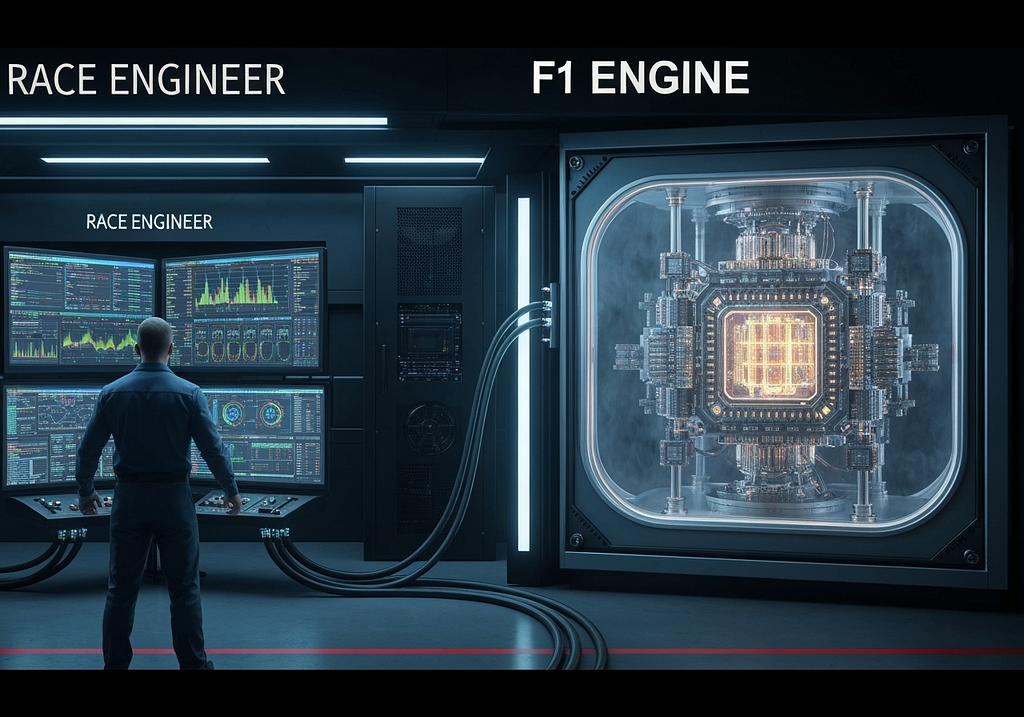
The hybrid model: A classical computer as the race strategist, and a quantum processor as the specialized, high-performance engine.
- The Classical Computer is the Race Engineer: It sits in the pit lane, analyzing data from the track, talking to the driver, and making the big strategic calls. It manages the entire learning loop (Chen & Meyer, 2021).
- The Quantum Processor (VQC) is the F1 Engine: It’s a small, ridiculously powerful, and highly specialized piece of hardware. It can’t run a whole race by itself, but it can do one thing a normal engine can’t: perform the mind-bending calculations needed to navigate the next corner with quantum precision.
The classical brain interacts with the world, collects data, and then tells the quantum engine how to “tune” itself. The quantum engine runs its calculation, the results are measured, and the feedback loop continues. This hybrid model, first practically demonstrated by Chen et al. (2020), was the bridge that connected the wild theory of QRL to something we can actually build and run today.
Trivia: The first practical framework for Variational Quantum Reinforcement Learning was proposed in a paper at the AAAI Conference on Artificial Intelligence in 2020 (Chen et al., 2020). This paper effectively kicked off the “NISQ-era” of practical QRL, moving it from theoretical physics into applied computer science.
IV. Where the Quantum Rubber Meets the Road
So, this isn’t just theory. Where is this “strategy-generating” AI actually making a difference?
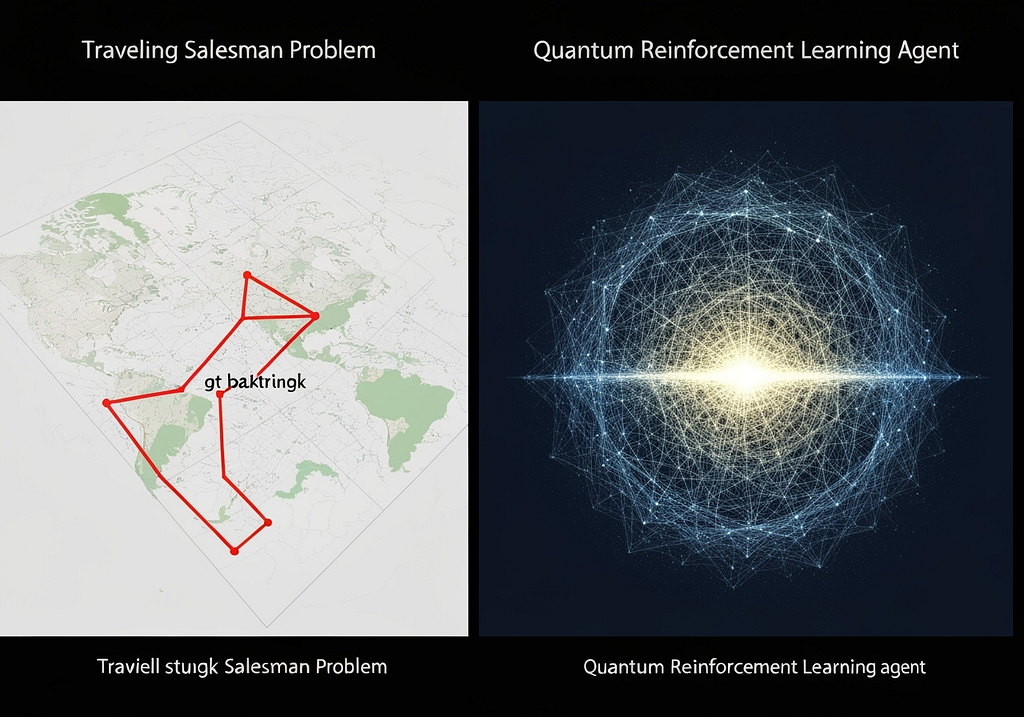
From theory to reality: QRL agents are already finding better solutions to some of the world’s hardest optimization puzzles.
A. Solving the World’s Hardest Puzzles
Remember our FedEx driver with 50 stops? That’s a classic combinatorial optimization problem. These puzzles are at the heart of logistics, scheduling, and network design. A team of researchers (Glos et al., 2022) unleashed a QRL agent on the famous Traveling Salesman Problem and found it could outperform both classical AI and other top-tier methods on standard benchmarks. The quantum agent’s unique ability to explore the vast solution space allowed it to find better routes, faster. This is huge.
B. Teaming Up with the Best of Classical AI
The really smart move? Don’t throw out the old playbook. Combine the strengths of classical and quantum AI. This is called Deep Quantum Reinforcement Learning (DQRL).
Here’s the setup: You use a powerful classical neural network (like the ones that power image recognition) to do the heavy lifting of processing raw, messy, real-world data. It chews through an image or a massive dataset and hands a neat, compressed summary to the quantum brain. The quantum circuit then does what it does best: makes the final, complex, strategic decision based on that summary (Hsu et al., 2021). It’s the ultimate dream team — the classical workhorse and the quantum superstar, playing to their strengths.
V. A Reality Check: The Bumps on the Road Ahead
I wouldn’t be a good friend (or a responsible scientist) if I sold you on the dream without giving you the gritty reality. This journey is a marathon, not a sprint. The road to true quantum advantage is paved with some serious potholes.
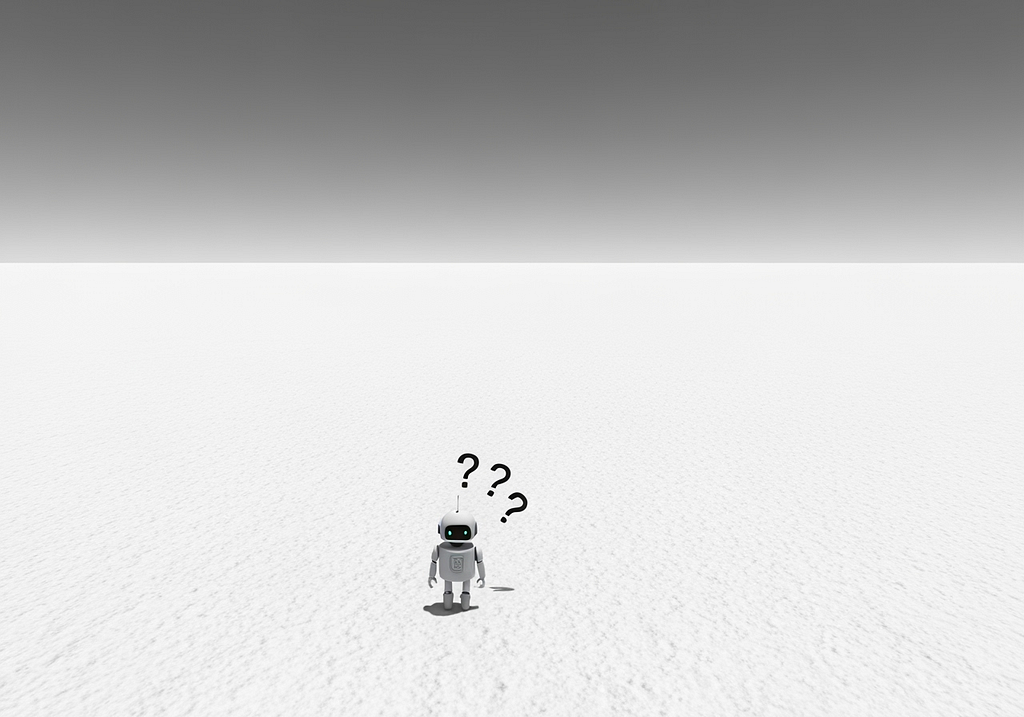
The “barren plateau” is one of the biggest challenges in QRL — when the AI gets stuck in a vast landscape with no clues on where to go next.
- The Hardware Problem: Today’s quantum bits, or qubits, are the divas of the computing world. They’re incredibly powerful but also incredibly fragile. The slightest bit of environmental “noise” can cause them to lose their quantum state (decoherence), introducing errors into the calculation. We’re still working on building bigger, better, and more stable quantum computers.
- The Algorithm Problem: The single biggest training nightmare for VQRL is a phenomenon called “barren plateaus” (McClean et al., 2018). Imagine our AI agent is trying to find the lowest point in a huge landscape. A barren plateau is like finding yourself in the middle of a perfectly flat, featureless desert the size of Texas. There are no hills or valleys to guide you; every direction looks the same. The agent gets completely stuck, and the learning grinds to a halt.
- The “Is It Actually Better?” Problem: Just because an algorithm has “quantum” in the name doesn’t automatically make it better. A brilliant paper on Quantum Natural Policy Gradients showed that naively “quantizing” a classical method doesn’t guarantee a win and can sometimes make things worse (Meyer et al., 2024). True advantage requires deep, clever insights into how to properly harness quantum effects, not just using them as a gimmick.
“The expert at anything was once a beginner.” — Helen Hayes
VI. The Post-Credits Scene: Your Mission, Should You Choose to Accept It
So, what does this all mean for you?
- For Leaders and Technologists: Stop thinking of QRL as a drop-in replacement for your current machine learning models. Start thinking of it as a long-term strategic weapon for solving a new class of currently “impossible” optimization problems. The time to start building institutional knowledge and identifying pilot projects is now.
- For Policymakers: The race for quantum advantage is real, and it has massive economic and national security implications. This isn’t science fiction. It requires sustained investment in research, hardware, and, most importantly, the people who will build this future.
- For Researchers and Builders: The challenges — noise, barren plateaus, data encoding — are not roadblocks; they are the most fertile ground for groundbreaking work. The goal is to co-design hardware and algorithms to close the gap between today’s promise and tomorrow’s reality.
We stand at the beginning of a paradigm shift. The first era of AI was about learning from the past. The current era of Generative AI is about creating novel content based on that past. The next era, powered by Quantum Reinforcement Learning, will be about generating optimal strategies for the future.

The next era of AI will be about generating optimal strategies for humanity’s greatest challenges.
It’s a monumental challenge, for sure. But the journey to creating an intelligence that can solve humanity’s most complex puzzles has already begun.
And that’s a story worth being a part of. Now, who wants more chai?
References
Foundational Theory & Quantum Advantage
- Arunachalam, S., & de Wolf, R. (2018). On the Quantum Advantage of Reinforcement Learning. In Conference on Learning Theory (COLT). http://proceedings.mlr.press/v75/arunachalam18a.html
- Wang, D., Sundaram, A., Kothari, R., Kapoor, A., & Roetteler, M. (2021). Quantum Algorithms for Reinforcement Learning with a Generative Model. In International Conference on Machine Learning (ICML). https://proceedings.mlr.press/v139/wang21au.html
Variational & Practical QRL (The NISQ Era)
- Chen, Z., Beck, K., Sun, C., & Wang, X. (2020). Variational Quantum Reinforcement Learning. In AAAI Conference on Artificial Intelligence (AAAI). https://ojs.aaai.org/index.php/AAAI/article/view/5753
- Chen, J. G. G., & Meyer, D. A. (2021). A Quantum Policy Gradient Algorithm. In International Conference on Machine Learning (ICML). http://proceedings.mlr.press/v139/chen21s.html
- Jerbi, S., Trenkwalder, L. M., Pekeur, S. P., & Briegel, H. J. (2021). Variational quantum Q-learning. Quantum, 5, 501. https://quantum-journal.org/papers/q-2021-07-08-501/
Advanced Algorithms & Future Directions
- Policicchio, A., Spaventa, D. D., Spisso, B., Strano, D., Cataliotti, F. S., Pellegrino, F. M. D., … & Falci, G. (2023). A Variational Quantum Soft Actor-Critic Algorithm for Continuous Control Tasks. ResearchGate. https://www.researchgate.net/publication/372659364
- Meyer, A., Kottmann, J. S., D’Elia, A., Ginsca, F., Vallecorsa, S., & Asfaw, A. T. T. (2024). On Quantum Natural Policy Gradients. arXiv preprint arXiv:2401.08307. https://arxiv.org/abs/2401.08307
- Skosana, U., & Tame, M. (2021). A quantum actor-critic agent for learning in a noisy environment. Quantum Machine Intelligence, 3(1), 1–13. https://doi.org/10.1007/s42484-021-00048-5
Applications & Hybrid Models (DQRL)
- Glos, A., Korbicz, J. K., & Wittek, P. P. Z. (2022). Quantum Reinforcement Learning for Solving Combinatorial Optimization Problems. In International Conference on Learning Representations (ICLR). https://openreview.net/forum?id=FRG049V1O5
- Kyriazis, I., Kim, J.-Y., & Plataniotis, K. N. (2023). Variational Quantum-Classical Reinforcement Learning for Trading Financial Assets. In IEEE International Conference on Acoustics, Speech and Signal Processing (ICASSP). https://doi.org/10.1109/ICASSP49357.2023.10193496
- Hsu, S. Y. Y., Hsieh, S. C. C., & Lin, S. H. H. (2021). Deep Quantum Reinforcement Learning. In IEEE International Conference on Acoustics, Speech and Signal Processing (ICASSP). https://doi.org/10.1109/ICASSP39728.2021.9414434
Disclaimer: The views and opinions expressed in this article are my own and do not necessarily reflect the official policy or position of any affiliated organizations. AI assistance was used in researching for and in drafting this article, including the generation of images. This work is licensed under a Creative Commons Attribution-NoDerivatives 4.0 International License (CC BY-ND 4.0).
Why the Future of Generative AI is Quantum Reinforcement Learning was originally published in Level Up Coding on Medium, where people are continuing the conversation by highlighting and responding to this story.
This content originally appeared on Level Up Coding - Medium and was authored by Mohit Sewak, Ph.D.

Mohit Sewak, Ph.D. | Sciencx (2025-10-03T02:41:29+00:00) Why the Future of Generative AI is Quantum Reinforcement Learning. Retrieved from https://www.scien.cx/2025/10/03/why-the-future-of-generative-ai-is-quantum-reinforcement-learning/
Please log in to upload a file.
There are no updates yet.
Click the Upload button above to add an update.