
This content originally appeared on Level Up Coding - Medium and was authored by Akhilesh Yadav
The Unseen Intelligence Beneath Our Feet
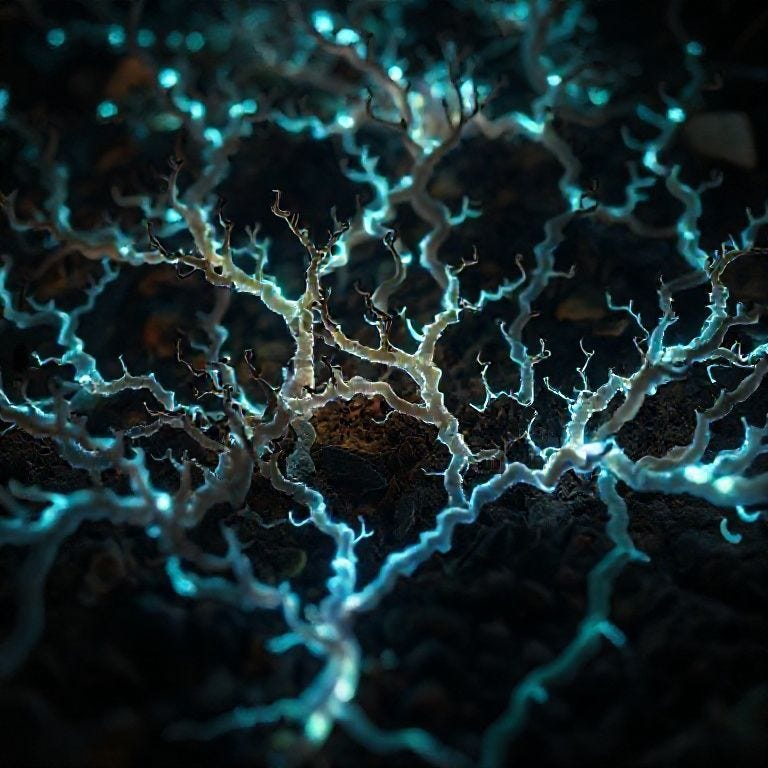
Imagine a future where computers grow, breathe, and even heal themselves. A future where the very building blocks of intelligence aren’t etched into brittle silicon, but woven into living, adaptable networks. Sound like science fiction? Get ready to have your mind bent, because the quiet revolution of fungal bio-computing is already here, redefining intelligence one mycelial network at a time.
For decades, we’ve pushed the boundaries of silicon, cramming more transistors onto smaller chips, chasing ever-faster processing. It’s been an incredible ride, leading to the AI marvels we see today. But let’s be honest, this path comes with a hefty price tag: massive energy consumption, mountains of electronic waste, and a fundamental fragility. Our digital world is brilliant, but it’s also incredibly demanding and, well, dead.
What if the answer to our computing woes isn’t in finding a better way to make silicon, but in looking for a completely different kind of substrate? What if the most powerful, energy-efficient, and sustainable “computer” has been right under our noses (and feet) all along? Enter the humble, yet astonishing, world of fungi.
The Mycelial Maestro: When Fungi Become Circuits
It’s easy to dismiss fungi as just mushrooms or mold. But beneath the forest floor, or within decaying wood, lies a hidden world of intricate networks: the mycelium. This vast, interconnected web of thread-like structures (hyphae) is how fungi communicate, transport nutrients, and explore their environment. And here’s the kicker: this biological network exhibits electrical activity, patterns of growth, and memory-like behaviors that bear a striking resemblance to… neural networks.
Fungal Logic Gates: The Bio-Digital Switch
At its core, a computer performs operations using logic gates — fundamental switches that process information based on inputs (like AND, OR, NOT gates). Silicon chips achieve this with transistors. But what if a fungus could do the same?
Researchers are actively exploring how the electrical and chemical signaling within mycelial networks can be harnessed to create these very logic gates. Think about it:
- Input: Introduce a stimulant (chemical, electrical, or even physical damage) at one point in the mycelium.
- Processing: The mycelium reacts, sending signals and changing its growth patterns.
- Output: Observe the resulting electrical pulses or growth responses at another point.
By carefully designing the network’s geometry and introducing specific stimuli, scientists have demonstrated that mycelial networks can indeed exhibit logic gate-like behavior. Imagine a network where two distinct external stimuli (inputs) are required to trigger a specific electrical spike (output) — that’s an “AND” gate, right there in a living organism!
Why is this mind-bending? Because it opens the door to truly organic, self-organizing computational systems. Instead of static, manufactured gates, we’re talking about gates that can adapt, grow, and potentially even self-repair.
Bio-AI Architectures: Growing Intelligence
Moving beyond individual gates, the grand vision is to build entire “Bio-AI architectures” using fungi. Picture mycelium as a living, breathing neural network. Researchers, most notably Professor Andrew Adamatzky from the University of the West of England, have been at the forefront of demonstrating how these fungal networks can compute.
His work, often published on platforms like arXiv, shows that mycelium can solve complex computational problems, like finding the shortest path through a maze, simply by growing. The network inherently seeks the most efficient route, demonstrating a form of parallel processing and optimization that silicon struggles with at scale.
How do these ‘myco-brains’ work?
- Chemical Gradients & Electrical Spikes: Fungi communicate via chemical signals and electrical impulses, much like our own neurons. These signals propagate through the hyphae, influencing growth and behavior.
- Adaptive Growth: The network adapts its structure based on environmental factors and resource availability. This plasticity is crucial for “learning” and problem-solving.
- Memory: Some studies suggest that fungal networks exhibit a form of short-term memory, responding differently to repeated stimuli. This is a rudimentary but essential component for any computational system.
Q&A: Diving Deeper into Fungal Computing
Q: Can fungi really “think” like a computer?
Ans: Not in the human sense of consciousness, but they exhibit complex information processing, decision-making, and adaptive behaviors that can be modeled computationally. They’re like highly parallel, decentralized, biological processors.
Q: How fast would a fungal computer be?
Ans: Currently, much slower than electronic computers for typical tasks. However, their strength lies in massively parallel processing, energy efficiency, and unique problem-solving capabilities (e.g., shortest path, pattern recognition) where biological methods might excel.
The Promise: What Can Fungal AI Bring?
The implications of robust fungal logic gates and bio-AI architectures are genuinely revolutionary:
- Sustainable Computing: Imagine data centers that grow from natural materials, consuming minimal energy and biodegrading at the end of their life. This is a monumental shift from our current environmentally taxing infrastructure.
- Self-Healing & Resilience: Unlike silicon, which breaks permanently, a living fungal network could potentially repair itself, regrowing connections and adapting to damage. This promises unprecedented robustness.
- Decentralized Intelligence: Mycelial networks are inherently distributed. This could lead to AI systems that are less prone to single points of failure and capable of localized, context-aware intelligence.
- Bio-Integrated Devices: Picture smart sensors woven into the environment, interacting with ecosystems directly, or even medical devices that organically integrate with the human body.
- Novel AI Paradigms: Beyond just replicating current AI, fungal computing could inspire entirely new ways of processing information, leading to forms of intelligence we haven’t even conceived of yet.
The Mycelial Hurdles: Real Talk About the Challenges
As thrilling as this future sounds, we’re still in the very early days. Building a scalable, reliable fungal computer comes with significant challenges:
- Speed: Biological processes are inherently slower than electrical signals in silicon. Bridging this speed gap is a major hurdle for widespread adoption in traditional computing tasks.
- Interfacing: How do we reliably input data into a living fungal network and extract meaningful outputs in a digital format? Developing robust bio-electronic interfaces is crucial.
- Control & Predictability: Living systems are notoriously complex and can be unpredictable. Maintaining stable conditions, controlling growth patterns, and ensuring consistent computational outcomes is a huge undertaking.
- Scalability: While mycelium can grow vast, ensuring precise connections and complex architectures on a large scale remains an engineering marvel to be solved.
- Ethical Considerations: As we delve deeper into bio-integrated AI, ethical questions around “living technology” will undoubtedly emerge.
The Path Forward: A Future Grown, Not Just Built
Fungal logic gates and bio-AI architectures aren’t here to replace your smartphone or cloud servers tomorrow. Instead, they represent a radical, inspiring shift in how we think about intelligence and computation. They challenge our silicon-centric bias and invite us to consider the profound intelligence embedded in the natural world.
This isn’t just about making faster computers; it’s about making smarter, more sustainable, and more symbiotic ones. It’s about learning from nature’s elegant solutions to build technology that truly belongs on our planet. The interdisciplinary research required for this — spanning mycology, computer science, materials science, and bio-engineering — is nothing short of breathtaking. We’re on the cusp of an era where our machines might just be alive.
What are your thoughts on growing computers? Do you think the future of AI is fungal? Share your insights and wildest predictions in the comments below!
Acknowledgements
This exploration is deeply inspired by the pioneering work of Professor Andrew Adamatzky and his team at the University of the West of England, whose research into unconventional computing with living substrates, particularly fungi, has paved the way for these incredible discoveries. Further insights were gathered from recent publications on arXiv and specialized journals in bio-computing. Diagrams were adapted for illustrative purposes.
#Biocomputing
Beyond Silicon: Unlocking Bio-AI’s Future with Fungal Logic Gates was originally published in Level Up Coding on Medium, where people are continuing the conversation by highlighting and responding to this story.
This content originally appeared on Level Up Coding - Medium and was authored by Akhilesh Yadav

Akhilesh Yadav | Sciencx (2025-11-11T22:41:27+00:00) Beyond Silicon: Unlocking Bio-AI’s Future with Fungal Logic Gates. Retrieved from https://www.scien.cx/2025/11/11/beyond-silicon-unlocking-bio-ais-future-with-fungal-logic-gates/
Please log in to upload a file.
There are no updates yet.
Click the Upload button above to add an update.