
This content originally appeared on Bits and Pieces - Medium and was authored by Hamnaghufran

You loved how Lovable let you sketch ideas and launch a working web app in minutes. Open the browser, drop a prompt and boom, you have a working app. That instant-creation rush is addictive, and for early prototypes, nothing beats it.
But the gap appears as soon as you move past the first release. Lovable’s fast-start code often turns into tightly connected files with limited test coverage, unclear versioning and no real structure for safe iteration. Adding new features becomes harder because the system lacks the tooling and discipline needed for production environments. Lovable gets you through day one, but it cannot support the realities of day two.
That’s when teams start looking for alternatives designed for long-term growth. These tools focus on the disciplines Lovable leaves out, such as architecture, testability, versioning, CI, dependency management and the ability to survive your second release.
In this guide, we’ll explore seven Lovable alternatives that keep the speed and creativity you enjoy while giving you the structure required to ship stable, scalable, production-grade software.
To make this easier, we’ve added a table below that compares how each alternative handles these production-grade needs.
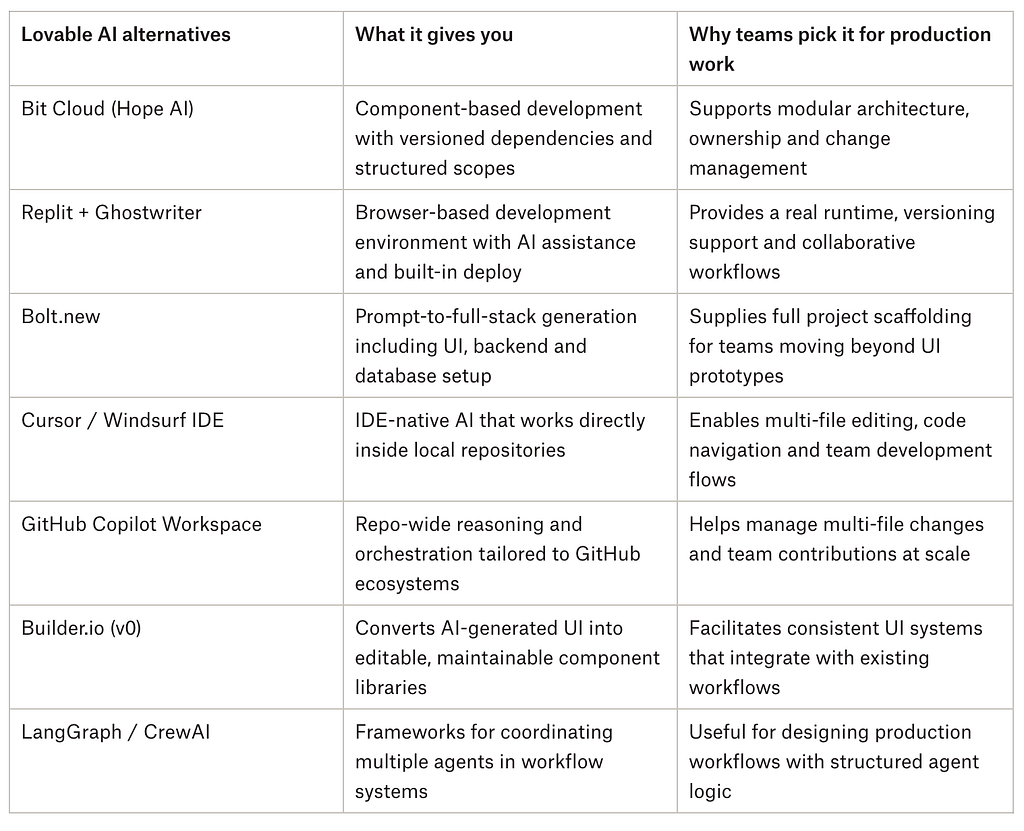
How we selected these Lovable alternatives
We selected platforms that help teams move beyond fast prototypes and into real software development. Each option supports the engineering practices that matter once an app grows past the first release. The focus is on durability, testability, versioning and the operational discipline required to maintain and evolve a system over time.
Our evaluation criteria reflect the core principles of production-grade, AI-assisted development:
- Architecture clarity: Does the platform produce a structure you can understand, review and extend without guesswork?
- Testability and validation: Are there mechanisms for generating tests, running checks or integrating with CI for safe iteration?
- Code readability: Is the output transparent, editable and maintainable by real developers across multiple releases?
- Versioning and change management: Does it support branch workflows, reviews, controlled updates and team visibility into changes?
- Operational scalability: Can the system support larger codebases, multi-file changes, team ownership and long-term evolution?
The 7 best Lovable alternatives
Here are the seven best Lovable alternatives to consider for your project:
Bit Cloud (Hope AI)
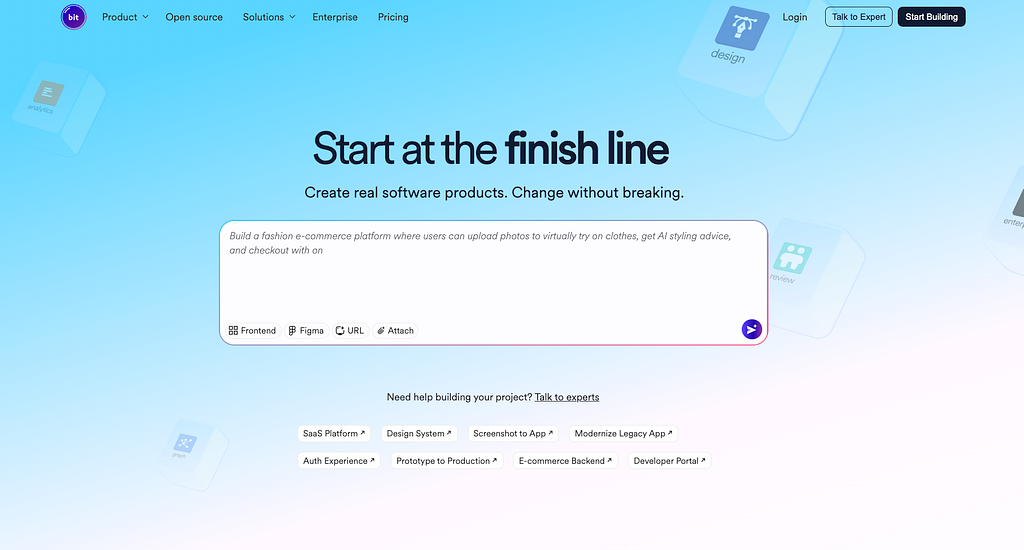
Bit Cloud is the only platform on this list that goes from prompt to production-grade software. It does not generate prototypes. It generates systems that can survive scale, teams and time. Where other tools focus on UI speed, code suggestions or isolated app generation, Bit Cloud handles the parts that actually matter once an app leaves the prototype stage: architecture, boundaries, tests, validation, versioning and day-two operations.
Bit Cloud synthesizes software as a full system. It defines domain-driven feature boundaries, establishes structure and generates code with tests, lint rules, validation layers and dependency handling already included. This prevents the drift and structural decay that happen in prototype-first environments.
Every change is governed. Bit Cloud creates versioned updates, change requests, traceable diffs and CI-ready output that can be deployed in an open garden or synced to Git. This ensures long-term maintainability across teams and incremental evolution without breaking the system.
It connects directly with AI agents, MCP memory and internal component hosting, giving organizations a controlled environment where multi-agent contributions remain safe, observable and reconstructible. Bit Cloud prioritizes day-two readiness: repair tools, observability, lifecycle awareness and safe iteration over time.
Ideal for:
- Teams maintaining systems that evolve for years
- Regulated and enterprise environments requiring traceability
- Multi-agent workflows where governance matters
- Any project expected to outlive its prototype phase
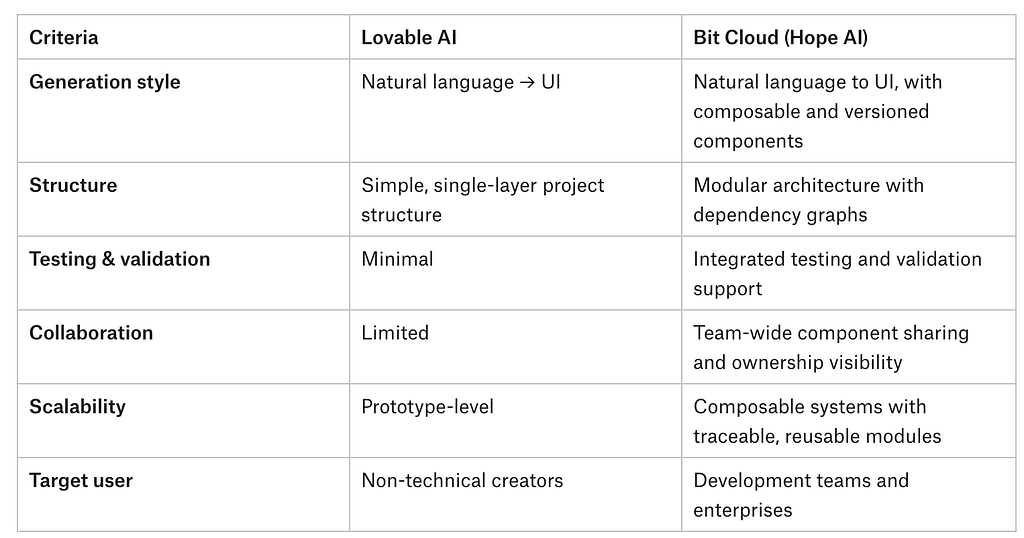
Lovable vs. Bit Cloud
Replit + Ghostwriter
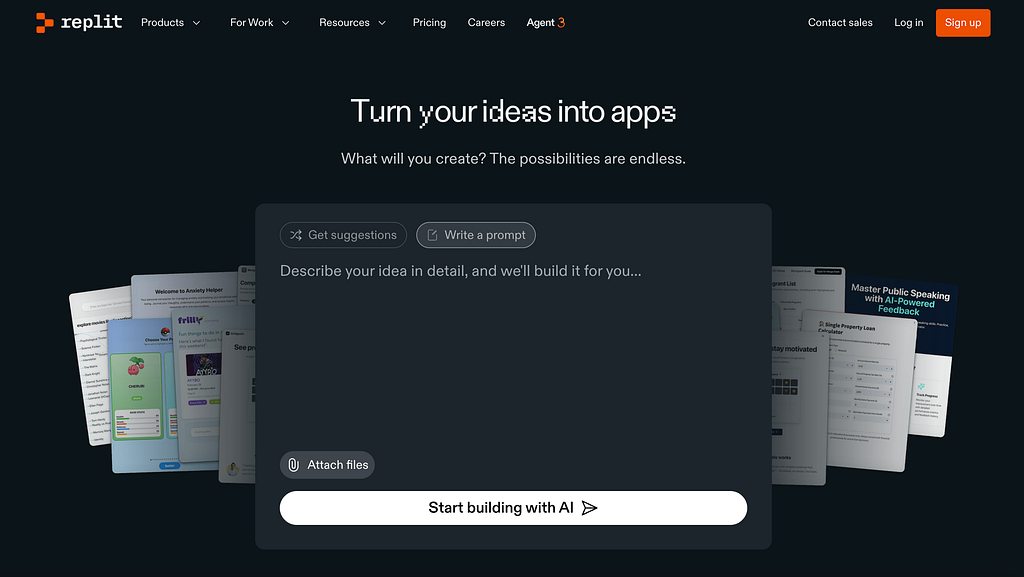
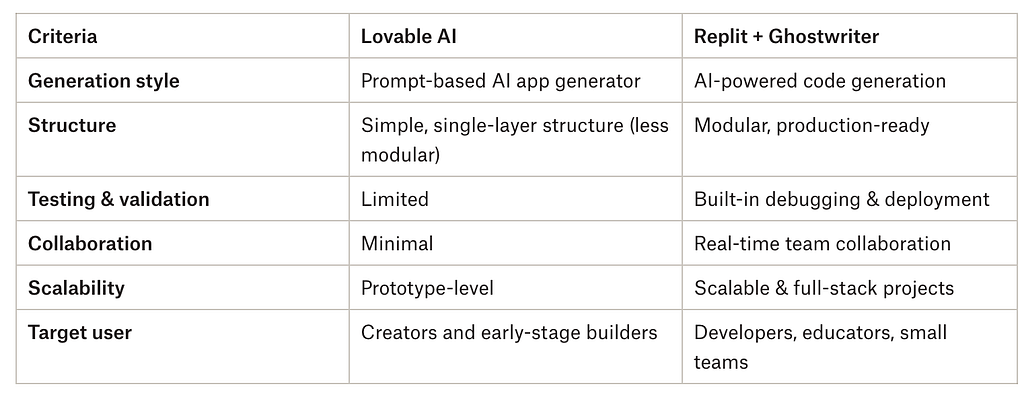
Replit provides a browser-based development environment for building, testing and deploying web or mobile applications. It includes a built-in IDE and AI coding assistant (Ghostwriter) that generates working code from natural language prompts. Projects support modular organization, version control and multi-contributor collaboration.
Compared with prototype-focused tools like Lovable, Replit supports versioning, code inspection, deployment workflows and multi-contributor management.
Where it fits:
- Solo developers creating MVPs or internal tools.
- Small teams collaborating on early-stage applications.
- Educators and mentors teaching web development and AI-assisted coding.
- Projects that need browser-based modular coding and version control.
What it lacks:
- Built-in enforcement of architecture or governance for long-term production systems.
- Automated testing pipelines or CI/CD workflows beyond standard code export.
- Advanced lifecycle management for complex multi-team projects.
- Tools for large-scale enterprise deployment or production monitoring.
Comparison to production criteria:
While it enables early-stage application development and collaboration, it does not inherently handle system-level concerns such as enforceable architecture boundaries, automated governance or production-grade lifecycle management.
Lovable vs. Replit
Bolt.new
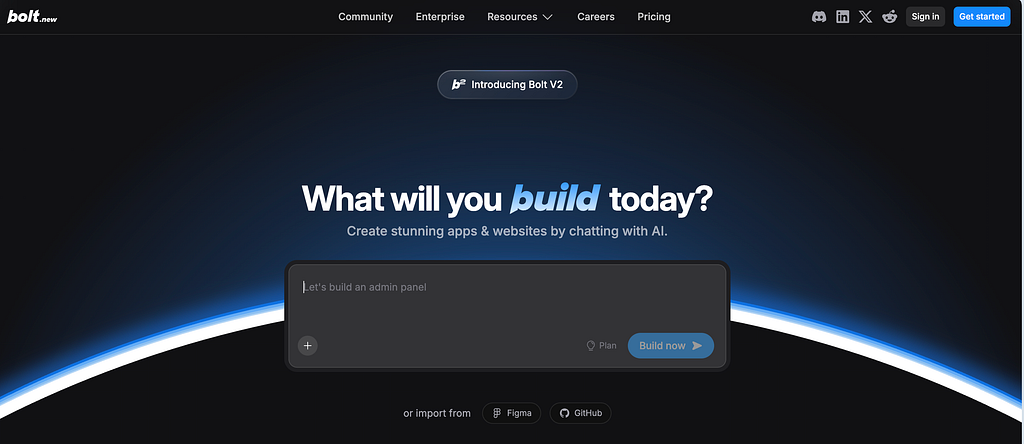
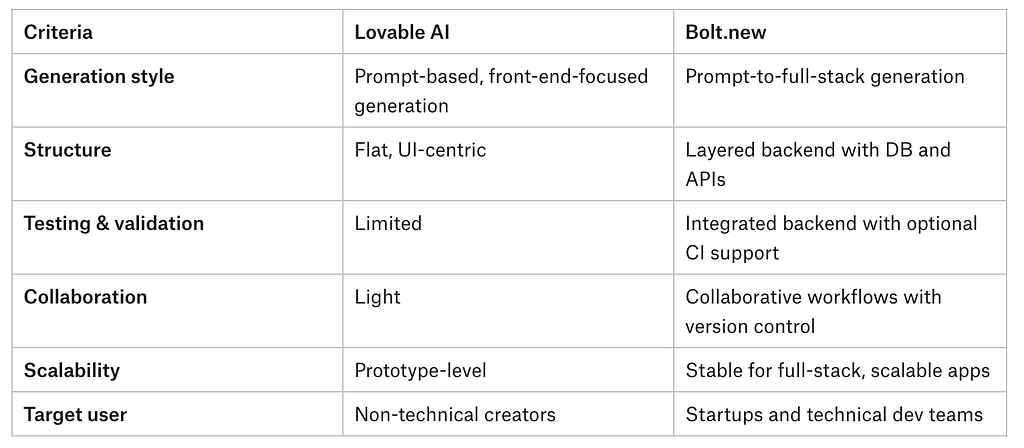
Bolt.new generates full-stack scaffolding from a prompt, producing a React frontend, Node/Prisma backend and Postgres database. Generated projects can be exported, edited and integrated with Git for version control.
It supports transitions from UI-only prototypes to functional applications with connected frontend and backend logic. Projects include basic scaffolding for testing and deployment but do not automate long-term governance or continuous integration workflows. Collaboration relies on standard Git processes without built-in team management or oversight.
Where it fits:
- Teams converting prototypes into full-stack applications.
- Projects requiring immediate frontend-backend integration.
- Developers or small teams using Git-based workflows.
What it lacks:
- Automated governance, testing or CI/CD.
- Integrated team collaboration and oversight.
- Long-term maintainability enforcement.
Comparison to production criteria:
Compared with production-focused tools, Bolt.new handles initial scaffolding and frontend-backend integration but does not address architecture enforcement, versioned change management, automated testing pipelines or operational observability. Teams using Bolt.new can implement these production-level practices separately.
Lovable vs. Bolt.new
Cursor / Windsurf IDEs
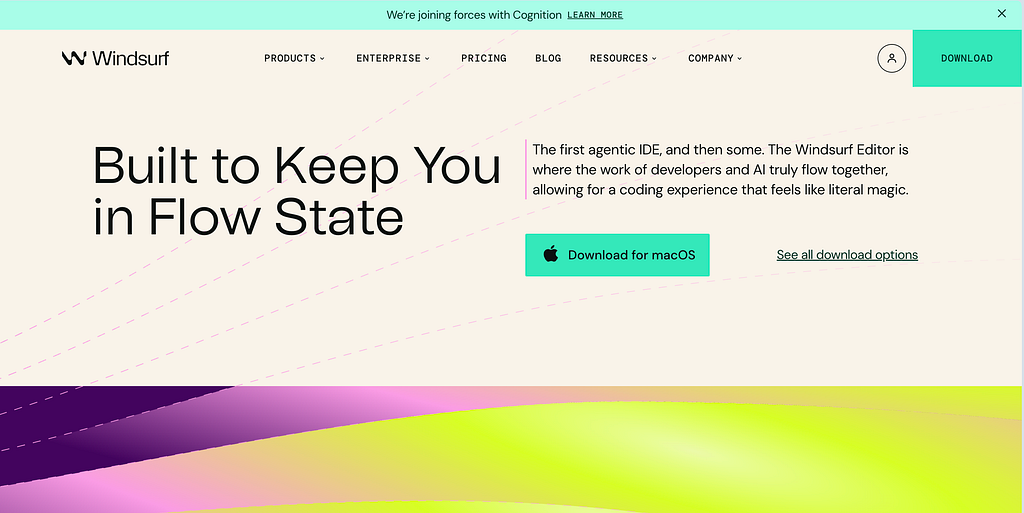
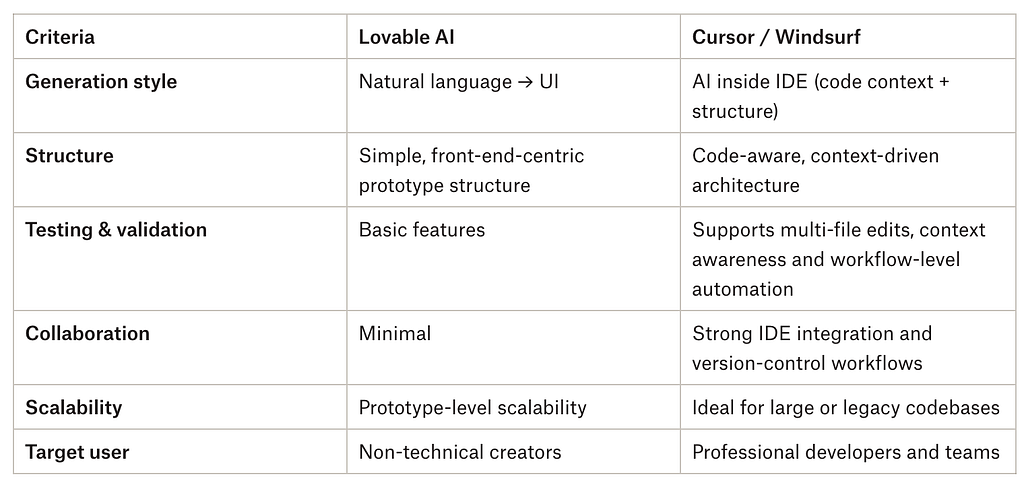
Cursor and Windsurf integrate AI code generation directly into existing development environments, including VS Code, local repositories and project setups. They can read across multiple files, understand project context and assist with refactoring or updating code consistently across a project.
These tools provide support for dependency management, version history and project-level governance. They enable AI-assisted development within established workflows, allowing developers to maintain architectural boundaries, testing structures and code consistency without switching to an external sandbox or isolated platform.
Where they fit:
- Mid-sized teams managing complex projects or legacy codebases.
- Enterprises enforcing architecture and compliance through version control.
- Developers using VS Code or Windsurf’s browser-based IDE seeking AI-assisted code reviews and updates.
What they lack:
- End-to-end project scaffolding for new applications.
- Automated deployment pipelines or CI/CD management.
- Native prototyping or rapid UI generation.
Comparison to production criteria:
Compared with production-focused platforms, Cursor and Windsurf enhance existing development environments with AI-assisted code updates and context-aware refactoring. They support architecture discipline, versioning and governance but do not provide complete scaffolding, automated testing pipelines or deployment management.
Lovable vs. Cursor / Windsurf
GitHub Copilot Workspace
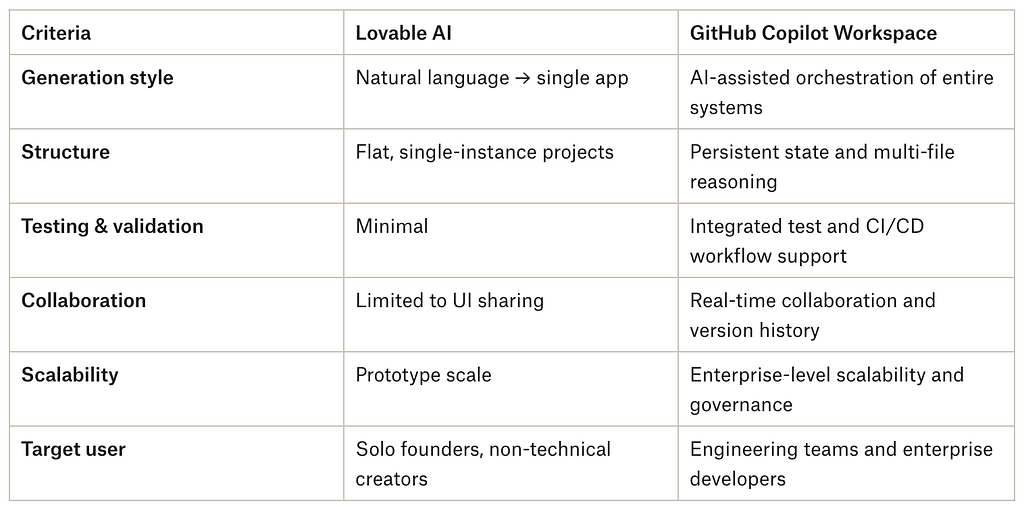
GitHub Copilot Workspace connects AI-generated code with a project’s architecture, workflow and team processes. It supports multi-file reasoning, workspace-wide context and collaborative updates across modules. Developers can iterate features in the context of the full system while maintaining alignment with existing architecture and dependencies.
It provides support for code analysis, dependency management, testing, refactoring and CI/CD integration. The platform maintains context across commits and can manage hooks, tests and documentation updates within the development workflow. This enables consistent updates and system-level coordination without requiring manual synchronization for each change.
Where it fits:
- Enterprises managing microservices, multi-repo workflows and internal tools.
- Platform teams coordinating AI-assisted pipelines with version governance.
- Teams combining AI agents with engineers on large or legacy codebases requiring long-term maintainability.
What it lacks:
- End-to-end scaffolding for new applications or prototypes.
- Built-in UI prototyping or rapid feature mockups.
- Automated enforcement of architecture beyond workspace-level coordination.
Comparison to production criteria:
Compared with prototype-focused tools like Lovable AI, Copilot Workspace addresses system-level coordination and workflow integration. It supports dependency management, testing, CI/CD integration and multi-module governance but does not replace the need for initial scaffolding, design decisions or external project-level deployment management.
Lovable vs. GitHub Copilot Workspace
Builder.io (v0)
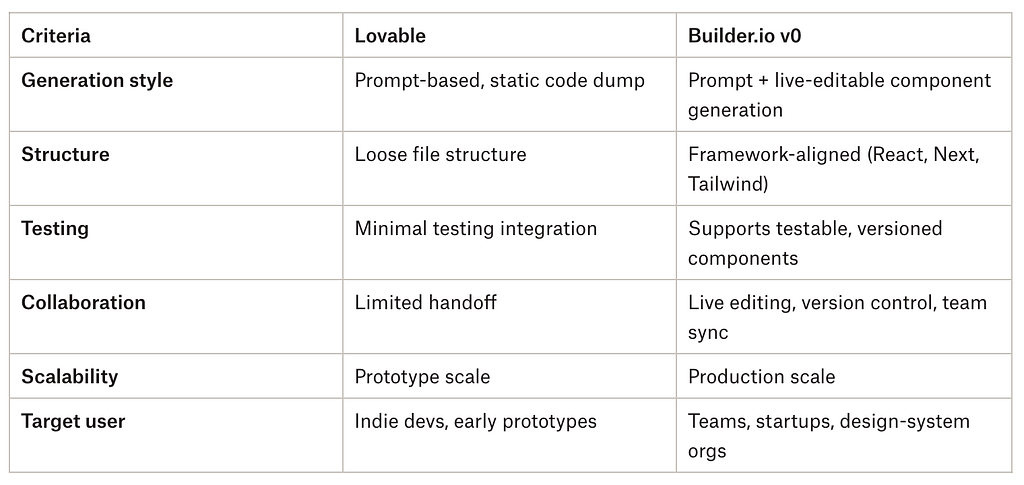
Builder.io v0 converts UI designs into modular, editable React or Tailwind components. It produces version-controlled elements that can be updated, reused and integrated into existing projects without replacing or overwriting the codebase.
It aligns with architectural frameworks such as Next.js and Remix, supporting live editing, code synchronization and schema-based design tokens. Structural consistency is maintained across components, enabling teams to manage design systems and prevent code decay as projects evolve.
Where it fits:
- Small teams or businesses working with established design systems.
- Startups transitioning from prototypes to production-ready products.
- Projects requiring component-level code reuse and maintainability.
What it lacks:
- End-to-end full-stack scaffolding or backend logic generation.
- Automated CI/CD pipelines or production workflow integration.
- AI-assisted multi-file refactoring beyond UI components.
Comparison to production criteria:
Compared with prototype-focused tools, Builder.io v0 provides a structured, version-controlled approach to UI generation. It addresses maintainability, component reuse and design system consistency but does not handle full backend integration, deployment automation or system-level governance.
Lovable vs. Builder.io
LangGraph / CrewAI
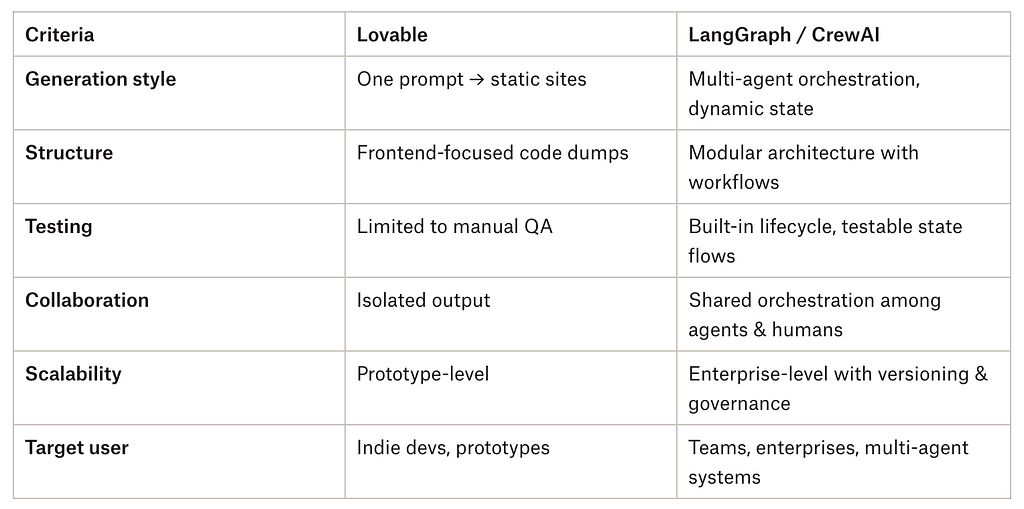
LangGraph and CrewAI provide frameworks for orchestrating multi-agent workflows, managing state, handling lifecycle events and enforcing governance in AI-driven systems. They coordinate interactions between multiple AI agents, human contributors and system modules through shared memory, context passing and structured state control.
These platforms support system deployment, versioning, updates and monitoring. They maintain traceability across agents, define task ownership and generate audit logs. Modular graphs and task definitions enable debugging, scaling and compliance management within complex, evolving systems.
Where they fit:
- Large-scale team workflows and multi-agent systems.
- Internal platforms or products that run continuously or evolve over multiple years.
- Enterprises and AI platform teams requiring lifecycle management and structured governance.
What they lack:
- Rapid UI prototyping or single-file code generation.
- End-to-end full-stack scaffolding for new applications.
- Built-in frontend-backend integration for early-stage MVPs.
Comparison to production criteria:
Compared with prototype-focused tools, LangGraph and CrewAI address system-level coordination, multi-agent orchestration and lifecycle governance. They provide structured workflows, traceability and compliance support but do not generate new application scaffolding or handle frontend-backend integration
Lovable vs. LangGraph/CrewAI
Feature comparison and architecture breakdown
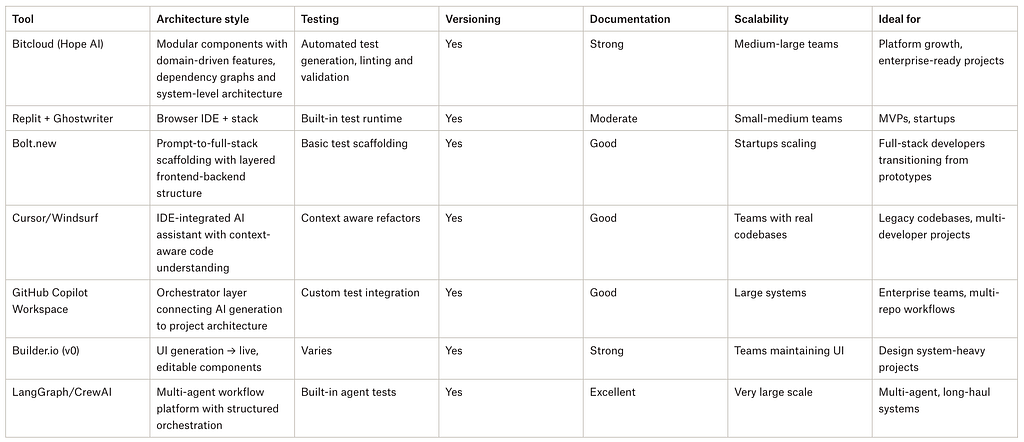
The architecture layer that makes AI production-ready
Architecture is what separates prototypes from platforms.
Where Lovable AI thrives on the speed of AI code generation, these Lovable alternatives thrive on the stability of evolution.
Patterns emerge fast when you look at the comparison above:
- IDE-based tools like Cursor and Windsurf bring AI-powered assistants directly into the real web development environment. They enhance workflows with inline explanation tools, collaboration and team-wide code intelligence.
- Platform-first tools like Replit and Bit Cloud aim to unify app generation, code deployment and team workflows into a cohesive ecosystem designed to scale beyond prototypes. You move from demos to production-ready code and from single app ideas to scalable full-stack apps.
- Finally, agent-orchestration frameworks like LangGraph and CrewAI represent a new tier of tools. They let you coordinate multiple specialized agents, support workflow decomposition and build systems that can scale with governance in mind.
When your web app’s logic sprawls across untested files with no history, what you’ve built isn’t software. It’s a demo created by a no-code visual editor. Fast, but fragile.
True production-ready systems are governed, observable and repairable. They survive version upgrades, human errors and midnight deploys.
When and how to switch from Lovable
Most developers don’t plan to outgrow Lovable. It just happens. If you need tests, version governance, CI, multi-component architecture, multi-team ownership, or the ability to evolve a system safely, you’ve already outgrown Lovable.
The three-stage transition path
1. Prototype / Validation Stage
- Tools: Lovable, Bolt.new, v0 (Builder.io)
- Focus: Speed, ideation and early app creation.
This stage is about exploration. Tools like Lovable and Bolt.new let you generate UI layouts, web apps and mobile frameworks in minutes using natural language prompts and visual editors. You can quickly validate ideas, run early user tests or spin up AI-assisted web experiences without deep coding knowledge.
Once you introduce real data, multi-user access or complex integrations, the limitations of prototype-focused tools become apparent. These systems are designed for speed and experimentation, not for scale or maintainability.
2. Integration Stage
- Tools: Replit + Ghostwriter, Cursor, Windsurf
- Focus: Connecting the prototype to real-world systems.
At this stage, developers begin integrating AI-generated code with existing workflows and IDEs. Replit, Cursor and Windsurf provide version control, live refactoring and deeper IDE integration. These tools support testing, collaboration and code evolution without breaking prototypes.
This stage bridges rapid experimentation and production readiness. Code becomes more structured, team collaboration is possible and you can start incorporating design systems and backend logic. However, governance, automated testing and multi-component orchestration remain largely manual.
3. Production Stage
- Tools: Bitcloud (Hope AI), Copilot Workspace, LangGraph / CrewAI
- Focus: Scalability, governance and system evolution.
At this stage, you move from generating code to building systems. Bitcloud, in particular, covers the full production lifecycle: it synthesizes architecture, establishes domain-driven feature boundaries, generates and validates tests, automates CI and self-repair, manages versioning and change requests, hosts internal components, supports open garden deployment, syncs with Git, integrates MCP memory and AI agents and provides enterprise governance.
Unlike earlier-stage tools, Bitcloud is designed for day-two readiness. It handles multi-component projects and multi-team ownership, ensuring that code can evolve safely over time. GitHub Copilot
Workspace and LangGraph/CrewAI complement these capabilities for orchestration, multi-agent coordination and lifecycle management, but no other tool in this stage combines architecture, testing, governance and system evolution as Bitcloud does.
In production-grade systems, the AI assistant is no longer a hobby partner. Every component is versioned, tested and auditable. The platform transforms ephemeral prototypes into maintainable systems capable of scaling with teams, dependencies and operational complexity.
If you’re debugging more than building, struggling to add new features or dreading every deployment, you’ve outgrown the playground.
Ask yourself:
- Do I need to scale this beyond one person?
- Does every change risk breaking something else?
- Is version governance starting to matter more than iteration speed?
If you said yes to even one, it’s time to evolve.
How to Switch Gracefully
Moving from Lovable AI to a production-ready tool doesn’t mean starting from scratch. Here’s a clear approach:
- Extract your working logic. Pull the functional parts from your Lovable code.
- Rebuild in a structured environment. Tools like Replit or Cursor help you reframe that logic into maintainable architecture.
- Add validation. Introduce Bitcloud’s test modules to give your code contracts.
- Connect your CI/CD. Let tools like Bitcloud or LangGraph run your updates safely.
- Document as you go. Transparency is the difference between building software and building chaos.
It takes time and effort. But the cost of structuring early is always less than the cost of patching later.
Conclusion
AI made building fast. The next wave is making it durable. Production-grade software is architecture, quality, governance and evolution. If you are ready for day two, choose tools designed for it. Systems that provide testing, version control, multi-component architecture, team ownership, CI automation and safe evolution enable prototypes to grow into maintainable, scalable and auditable software.
The shift is clear: speed built the first wave of apps. Endurance builds the next.
Top 7 Lovable alternatives for production-grade apps in 2026 was originally published in Bits and Pieces on Medium, where people are continuing the conversation by highlighting and responding to this story.
This content originally appeared on Bits and Pieces - Medium and was authored by Hamnaghufran

Hamnaghufran | Sciencx (2026-02-09T11:53:59+00:00) Top 7 Lovable alternatives for production-grade apps in 2026. Retrieved from https://www.scien.cx/2026/02/09/top-7-lovable-alternatives-for-production-grade-apps-in-2026/
Please log in to upload a file.
There are no updates yet.
Click the Upload button above to add an update.